Catering oil recycling near Islington: bin rules and collection
For catering oil recycling near Islington, don’t pour used cooking oil down the sink or put it in the general bin. Commercial kitchens need to keep waste oil separate and arrange a suitable collection. Household guidance about sealing oil in a container for general waste does not apply to catering waste.
When used oil builds up in a busy kitchen, it helps to know the right disposal route. Commercial oil must be handled separately from household waste, and London’s reuse and recycling centres do not accept trade waste. Keeping oil out of drains also helps prevent pipe blockages and fatbergs.
This guide explains how commercial oil collection and Waste Transfer Notes work, and what to consider when arranging a collection for an Islington kitchen. It also explains how collected cooking oil is recycled into bio-diesel, what records your business needs and how a collection service fits into a compliant disposal process.
Key Takeaways
- Keep catering oil out of sinks and household bins; commercial waste needs a suitable collection route.
- Understand how collection frequency can fit the amount of oil your kitchen produces.
- See which north London recycling centres accept household cooking oil, and why they aren’t an option for trade waste.
- Trace how collected cooking oil can be cleaned and processed into biofuel.
- Learn how a commercial collection can help keep waste records in order and put used oil to further use.
Used cooking oil collection in London
Commercial cooking oil needs a separate route from household rubbish. Islington recycling centres accept household oil, but not trade waste from restaurants or other businesses.
Commercial kitchen oil collection
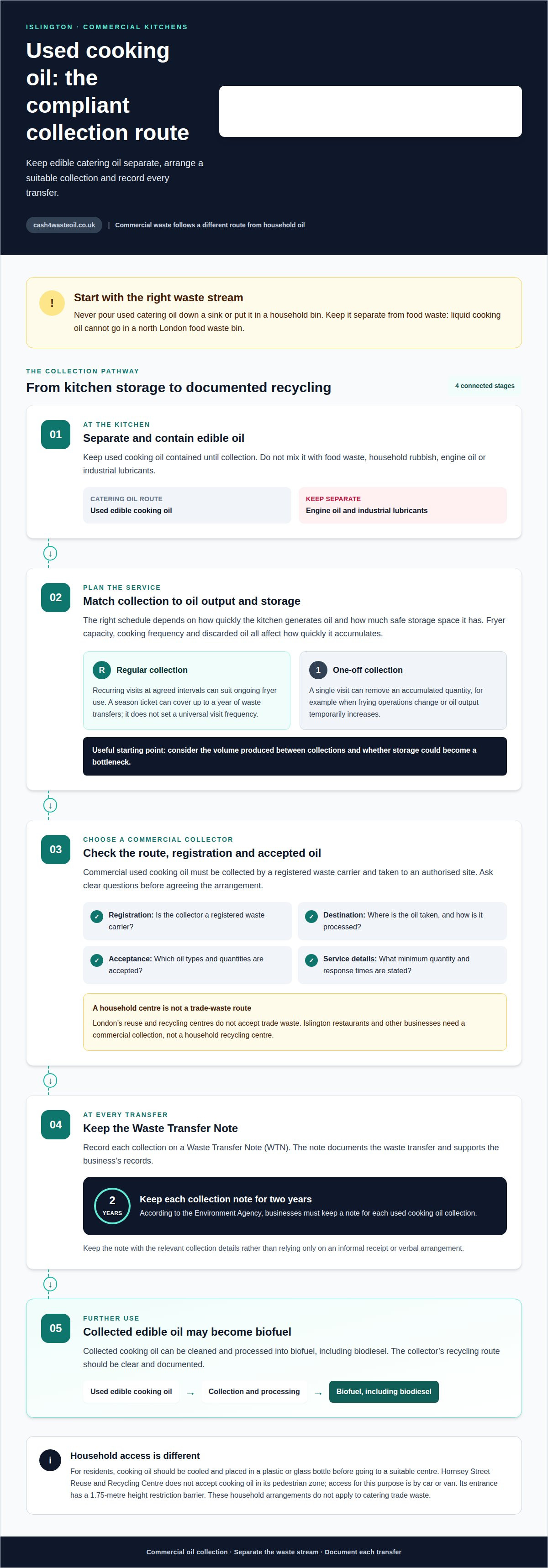
Commercial kitchen oil collection removes used cooking oil from a business for appropriate handling and recycling. Restaurants, pubs, hotels and other kitchens should arrange a commercial collection rather than take trade oil to a reuse and recycling centre. Commercial used cooking oil must be collected by a registered waste carrier and taken to an authorised site. Keep it separate from food waste: liquid cooking oil cannot go in a food waste bin in north London.
Keep used oil contained until collection, and never pour it into a sink, where it can block pipes or contribute to fatbergs in London’s sewers. A commercial collection keeps oil within the appropriate waste route, without relying on a household recycling centre for business disposal.
Collector options and accepted oils
A commercial oil collector is a service that takes used cooking oil from a catering business for recycling or processing. Collectors accept used edible cooking oil; engine oil and industrial lubricants are different waste types. There is no single minimum quantity stated for all Islington collectors, so the accepted volume depends on the collection arrangement. Ask about the minimum and accepted oil types when arranging service.
Household recycling centres are not an alternative for a catering business: trade waste is not accepted at London’s reuse and recycling centres. For residents, cooking oil should be cooled and placed in a plastic or glass bottle before being taken to a suitable centre. Hornsey Street Reuse and Recycling Centre does not accept cooking oil in its pedestrian zone; access for this purpose is by car or van. Its entrance also has a 1.75-metre height restriction barrier.
Service comparisons and paperwork
Compare collectors by their recycling route, registration as a waste carrier, accepted oil types, minimum quantity and stated response times. Ask where collected oil is taken and how it is processed; clear answers help distinguish a documented recycling service from an informal disposal arrangement. Choose a collection schedule that works with the kitchen’s oil output and storage capacity.
Each collection should be recorded on a Waste Transfer Note. According to the Environment Agency, businesses must keep a note for each used cooking oil collection for two years. The document records the waste transfer and supports the business’s records. Keep the note with the relevant collection details, rather than relying only on an informal receipt or verbal arrangement.
Collection frequency
Collection frequency is how often a commercial kitchen’s used cooking oil is removed. The right schedule depends on how quickly the kitchen generates oil and how much safe storage space it has. A busy restaurant using several fryers may accumulate oil faster than a small kitchen that fries occasionally, so their collection needs can differ.
A regular schedule means collections recur at agreed intervals. For regular waste collections, a season ticket can cover up to a year of waste transfers. That supports an ongoing arrangement, but it does not set a universal visit frequency for every Islington kitchen. The useful starting point is the volume generated between collections: a kitchen producing oil steadily needs a schedule that prevents storage becoming a bottleneck.
A one-off collection removes an accumulated quantity of used oil on a single visit. It may suit a kitchen changing its frying operation or handling a temporary increase in oil output. For businesses with regular fryer use, a recurring schedule can make collection easier to manage. In either case, choose a plan that reflects how much oil the kitchen generates.
Engine oil and industrial lubricants are examples of hazardous waste, unlike edible used cooking oil. Diesel is a fuel, not a substitute category for catering oil, so keep these materials separate from the used cooking oil stream. A catering collection for edible oil should not be treated as an outlet for engine or industrial oils. Separating waste types helps ensure each material follows an appropriate route.
Commercial fryer oil collection removes used oil from fryers in restaurants and other catering kitchens. Fryer capacity, how often cooking takes place and the amount of oil discarded all affect how quickly waste accumulates. For example, a kitchen that fries throughout service may fill its storage container sooner than one that uses a fryer occasionally. Use that difference to plan a practical collection schedule.
For an Islington business, planned collections can help keep oil storage manageable and make waste transfers easier to record. A one-off visit can address a single build-up, while regular collections suit ongoing production. The collected edible oil may later be processed into biodiesel, but that does not make diesel or hazardous oils part of the same collection stream. For commercial used cooking oil collection, match the arrangement to the kitchen’s output and storage needs.
Coverage in Islington and other London boroughs
Collection coverage describes the places reached by a service, while recycling-centre access describes where residents can take household oil. These are different routes. London’s reuse and recycling centres do not accept trade waste, so a restaurant in Islington needs a commercial collection route rather than a household centre.
Commercial used cooking oil collection removes a business’s waste oil through a suitable commercial service. Whether your kitchen is in Islington, Angel or near Upper Street, use a registered waste carrier that takes the oil to an authorised site. A business collection service and a public recycling centre are separate options.
For household cooking oil, North London residents can use the area’s reuse and recycling centres. The listed locations are:
- Summers Lane in Barnet
- Regis Road in Camden
- Edmonton EcoPark and Barrowell Green in Enfield
- Western Road in Haringey
- Hornsey Street in Islington
- Kings Road and South Access Road in Waltham Forest
These named sites help residents identify local options, but they don’t provide a disposal route for restaurant or catering waste. Hornsey Street Reuse and Recycling Centre has specific access conditions: cooking oil cannot be brought through its pedestrian zone and must arrive by car or van. The entrance also has a 1.75-metre height restriction barrier. The site may close briefly during operating hours while containers are moved or changed.
For household drop-off, let cooking oil cool and pour it into a plastic or glass bottle before taking it to a reuse and recycling centre. This household guidance does not make those centres suitable for a commercial kitchen. Trade waste remains excluded, even if a business is close to Hornsey Street or another listed site.
Commercial collection coverage and public recycling locations are not interchangeable. An Islington kitchen needs a registered carrier and an authorised destination, while a resident may use a local centre for household oil. This distinction applies across North London, including Barnet, Camden, Enfield, Haringey and Waltham Forest. The named centres are household drop-off points, not commercial collection services.
For businesses comparing catering oil recycling near Islington, focus on whether the commercial collection route serves the premises and where the waste is taken. The borough names above describe household centre locations, not a promise that a commercial collection operates throughout each borough. Keep the distinction clear when planning a business’s waste route.
Oil recycling and biofuel production
Used cooking oil recycling is the collection and processing of discarded edible oil into reusable materials, including biofuel. For London kitchens, the route starts when a commercial collector removes the waste oil and transfers it for processing. It doesn’t go straight from a fryer into a vehicle’s fuel tank. The oil must first be filtered, cleaned and processed before conversion into biodiesel or other renewable fuels.
Processing turns waste cooking oil into a usable feedstock for another purpose. In Norfolk, used cooking oil is cleaned and reprocessed for reuse as biofuel. Filtering and cleaning prepare the oil for conversion, while further processing creates fuel suitable for use beyond the kitchen. This sequence gives edible oil a defined route after collection, rather than leaving it mixed with general rubbish or poured into a drain.
For classification, used cooking oil is non-hazardous waste under code 20 01 25 for edible oil and fat. That code identifies the waste stream; it doesn’t mean that every type of oil belongs in it. Engine oil and industrial lubricants are separate materials, so catering oil should remain distinct during collection and handling. Clear separation helps the oil reach the appropriate recycling process.
Keeping cooking oil out of sinks also matters for London’s sewer network. Fats, oils and grease cause more than 20,000 blockages a year across Thames Water’s network, accounting for 28% of sewer blockages. Fats, oils and grease can also contribute to sewer flooding incidents. Oil poured down a kitchen sink can contribute to pipe blockages and fatbergs, creating an environmental and infrastructure problem beyond the premises.
Oil taken to a north London reuse and recycling centre is converted into biofuel for the distribution and power-generation industries. That route differs from commercial collection: London reuse and recycling centres don’t accept trade waste. Catering businesses therefore need a commercial collection route, while the centre’s conversion process shows how household cooking oil can also become fuel.
The practical outcome is a chain of distinct steps: collection, filtering, cleaning, processing and conversion. The final fuel may be biodiesel or another renewable fuel, rather than fresh cooking oil. In Norfolk, reprocessing returns used oil to a productive use; in north London, centre-collected oil serves distribution and power generation. Keeping oil separate from sinks, street drains and unrelated waste streams helps preserve that route from kitchen disposal to fuel production.
Which companies collect and recycle used cooking oil from catering businesses in Islington?
A commercial used cooking oil collector removes edible waste oil from a business and sends it to an authorised site. In Islington, restaurants, pubs, hotels and other commercial kitchens need this business collection route; local reuse and recycling centres do not accept trade waste.
A commercial collection in Islington, including the Angel and Upper Street area, must use a registered waste carrier and take the oil to an authorised site. This distinguishes a suitable catering collection from household drop-off. A nearby recycling centre is not a substitute, even if it accepts cooking oil from residents.
For a business choosing a collection arrangement, the key points are the service area, waste type, collection route and documentation. A collector should be able to explain whether it takes edible cooking oil from the premises and where that oil goes afterwards. Ask about accepted oil types and minimum quantities too, since those conditions affect whether a particular collection suits a small café or a busy restaurant.
Recycling credentials matter because collection is only one stage of the waste route. Collected oil can be filtered, cleaned and processed for conversion into biodiesel or other renewable fuels. A clear explanation of the destination and processing route helps a catering business understand what happens after the oil leaves its kitchen. Keep the answer aligned with the waste type: edible cooking oil is not engine oil or an industrial lubricant.
Paperwork is another practical distinction between a documented commercial arrangement and an informal handover. Each used cooking oil collection should have a Waste Transfer Note. The Environment Agency says businesses must keep one for each collection for two years. Retain the note with the relevant waste records so each transfer has a corresponding document.
For catering oil recycling near Islington, proximity alone does not establish that a service is suitable. Check that the collector’s route covers the business address, accepts the kitchen’s edible oil and transfers it to an authorised site. A service operating in Angel or Upper Street may be relevant to nearby premises, while a household centre remains unavailable for trade waste.
The practical choice is a commercial collector that handles the business’s oil type and provides the required transfer record. That route suits ongoing kitchen waste better than trying to use a resident facility such as Hornsey Street Reuse and Recycling Centre. Match the collection to the premises and the waste stream, then keep the paperwork for each transfer.
Cash 4 Waste Oil
Cash 4 Waste Oil provides a practical commercial route for used cooking oil from Islington kitchens. Its collections serve restaurants, pubs, hotels and other commercial kitchens, with coverage across London, Kent and Surrey. The service includes Waste Transfer Notes to document collections and cash payments for waste oil.
For a catering business, this brings collection and transfer paperwork into one arrangement. It’s relevant when used edible oil needs a professional collection rather than household disposal or a recycling-centre drop-off. The collected oil can then follow the appropriate recycling route, while the business retains its collection documentation.
If your kitchen needs a commercial collection for used cooking oil, contact Cash 4 Waste Oil to discuss the service.
Set up a clear next step for your kitchen
Make the next decision about how oil collection should fit your kitchen’s working routine. Consider which premises need coverage, where used oil accumulates and how the collection arrangement can work alongside service hours. A clear outline helps keep the discussion focused on your operation, rather than a generic schedule.
If you’re arranging catering oil recycling near Islington, take the next step with a commercial collection provider. Cash 4 Waste Oil can discuss the needs of your business and explain how its service fits your used cooking oil requirements.
Contact Cash 4 Waste Oil to discuss your kitchen’s collection needs and move towards a practical arrangement.
Frequently Asked Questions
Can I put used cooking oil in the general bin?
For a catering business, don’t use the household general bin for used cooking oil. Keep commercial oil separate and arrange collection through a commercial waste service. Household advice differs: residents unable to use a recycling centre or food waste service can seal oil in a container and put it in general waste. A restaurant’s waste remains commercial, even if the quantity is small.
How is the price of used cooking oil determined?
The payment rate depends on the oil’s volume and condition. Cash 4 Waste Oil provides a free quote rather than publishing a fixed rate, so businesses can get terms based on their own collected oil. For example, a kitchen producing a steady quantity should provide an accurate estimate when requesting a quote. The quote gives the relevant rate; there is no single published amount to apply to every collection.
Which used cooking oil collection services operate near Islington and cover my postcode?
Cash 4 Waste Oil collects used cooking oil from commercial food-service premises across London, including Islington. Its service is for businesses such as restaurants, pubs, hotels, cafés and other commercial kitchens, not domestic households. A catering site in Angel or Upper Street can use the commercial service. The relevant distinction is the premises and waste type: this collection is for edible cooking oil, vegetable oil and animal fats.
How much does commercial cooking oil collection cost in Islington, and are collections free?
Cash 4 Waste Oil’s commercial used cooking oil collection is free, and the business pays cash for collected waste oil. The payment amount depends on volume and condition, so it varies between kitchens rather than following a fixed public rate. A restaurant seeking the amount for its own collection can request a free quote. The collection itself has no charge; don’t confuse its cost with the separate payment rate.
Do oil recyclers pay catering businesses for used cooking oil, and what are current rates?
Cash 4 Waste Oil pays catering businesses cash on collection, but it doesn’t publish a fixed rate. The amount depends on the collected oil’s volume and condition, so a single rate would not describe every kitchen’s payment. The business provides a free quote for the relevant circumstances. This means the useful figure is the quote for your collection, rather than an assumed market rate or a number from another business.
How often can restaurants and caterers arrange used cooking oil collection in Islington?
Restaurants can arrange flexible weekly, fortnightly or monthly collections, with the schedule matched to their oil generation. A kitchen with steady fryer use may need a different rhythm from a café producing less waste oil. Cash 4 Waste Oil bases the arrangement on the business’s generation rate. This gives caterers set schedule options without treating every Islington premises as if it produces the same quantity.
What UK and Islington rules apply to storing and disposing of commercial waste cooking oil?
A Waste Transfer Note records each collection. According to the Environment Agency, businesses must keep a Waste Transfer Note for each used cooking oil collection for two years. Keep edible cooking oil separate from engine oil and industrial lubricants, which are different waste types and do not belong in the catering oil stream.
What are the risks of pouring cooking oil down drains, and how should a commercial collector advise businesses to store it before collection?
Oil poured down a drain can contribute to blocked pipes and fatbergs in London’s sewers. According to UK Parliament, improperly discharging material into a public sewer under section 111 of the Water Industry Act 1991 can carry up to two years’ imprisonment on conviction in the Crown Court. Before collection, keep used oil contained and separate from other waste, and follow the collector’s practical storage instructions.