Licensed cooking oil collection costs for Wandsworth restaurants
A disposal bill isn’t the only option for Wandsworth restaurants. Used cooking oil can be collected without a fee, and a collection arrangement can include cash payment for the oil. For restaurants seeking licensed oil disposal near Wandsworth, the key is understanding what the collection terms cover before choosing a service.
It’s reasonable to want clear costs, reliable paperwork and a straightforward collection process that fits a busy kitchen. This article explains whether restaurants pay for collection, what to compare when reviewing quotes, and why a Waste Transfer Note matters.
You’ll also find out which Wandsworth postcodes are covered, where collected oil can go for recycling, and what information helps make a quote relevant to your kitchen. The aim is simple: help you understand the arrangement, keep the paperwork in order and make a practical choice for your business.
Key Takeaways
- Understand what can affect a collection quote, including the amount of oil and the practicalities of access to your premises.
- Find out how to assess postcode coverage and arrange a collection that suits your restaurant’s needs.
- See how used cooking oil may be recycled into products such as biodiesel and Sustainable Aviation Fuel.
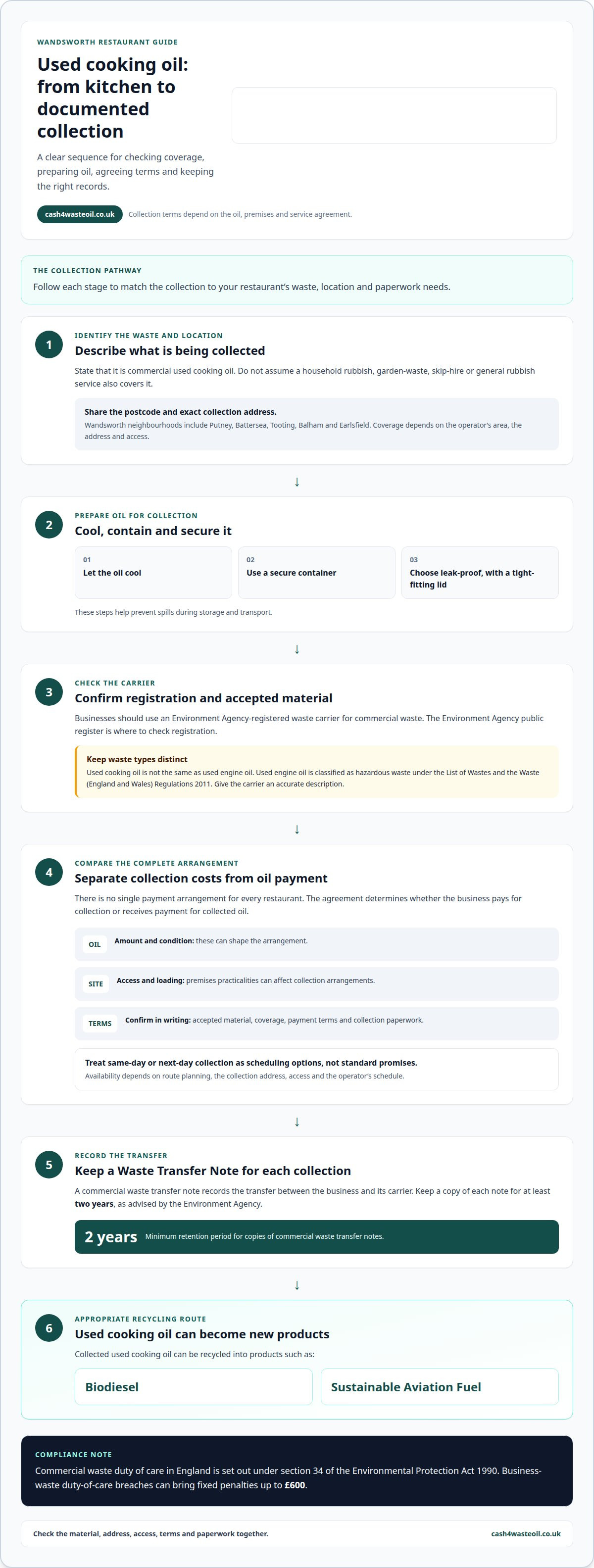
- Keep a copy of each commercial waste transfer note for at least two years, as advised by the Environment Agency.
- Learn what to compare in a collection arrangement, from paperwork to payment terms.
Do restaurants have to pay for cooking oil collection?
There is no single payment arrangement for every Wandsworth restaurant. The agreement determines whether a business pays for collection or receives payment for collected oil. The amount and condition of the oil, collection access and service terms shape that arrangement. Treat collection and payment as separate points when assessing the overall value.
Wandsworth Council rubbish collection and private commercial waste collection serve different needs. A restaurant should not assume its usual rubbish collection also covers used cooking oil. Clarify which waste stream a service handles, how the oil is collected and what paperwork comes with the collection. For example, a kitchen in Battersea may need a commercial arrangement suited to its premises and waste-handling routine.
Commercial waste duty of care in England is set out under section 34 of the Environmental Protection Act 1990, according to UK Legislation. Businesses should use an Environment Agency-registered waste carrier for commercial waste. The Environment Agency public register is the place to check a carrier’s registration. This is a practical compliance step, whether the collection is arranged privately or through another commercial route.
Coverage depends on the collection service’s operating area and the restaurant’s exact address. Wandsworth includes neighbourhoods such as Putney, Tooting, Balham, Battersea and Earlsfield. A postcode helps identify the location, but does not by itself explain collection terms or access. A kitchen on a busy road, for example, may have different loading arrangements from one with a rear service entrance.
Same-day and next-day collection are scheduling options, not standard promises. Availability depends on route planning, the collection address, access and the operator’s schedule. A restaurant with urgent rubbish removal needs should distinguish general waste collection from used-oil handling. Oil collection involves its own arrangements, so a general same-day rubbish service should not be assumed to cover it.
Before agreeing to a collection, establish the practical terms in writing. Confirm whether the arrangement charges for collection or pays for oil, which material is accepted, and how the collection is recorded. A commercial waste transfer note documents the transfer. The restaurant and carrier should retain clear records for each collection, rather than relying on a general rubbish-removal receipt.
For a restaurant comparing licensed oil disposal near Wandsworth, the useful comparison is the complete arrangement, not just whether a collection is described as free. Check the carrier’s registration, accepted waste, payment terms, collection coverage and paperwork together. That gives the business a clearer picture of cost, compliance and day-to-day handling before it chooses a service.
Waste disposal coverage across Wandsworth postcodes
Waste disposal coverage depends on the material, address and collection arrangement. Household, garden and commercial waste follow different routes, so identify the waste stream before arranging removal.
In England, commercial waste duty of care is set out under section 34 of the Environmental Protection Act 1990, according to UK Legislation. Business-waste duty-of-care breaches can bring fixed penalties up to £600. Waste oil must be handled responsibly, not dumped illegally.
For safe handling before collection, used cooking oil should cool before transfer. It should then go into a secure, leak-proof container with a tight-fitting lid. This helps prevent spills during storage and transport. A registered waste carrier should manage commercial waste collection and take it through an appropriate disposal or recycling route.
Postcode coverage
Wandsworth addresses span neighbourhoods including Putney, Battersea, Tooting, Balham and Earlsfield. A postcode helps identify the collection location, but the waste type and access also affect the arrangement. For example, a restaurant’s commercial oil is different from household rubbish or garden waste. Skip hire and general rubbish removal are separate services, so don’t assume they cover waste oil.
Commercial waste transfer notes record the transfer between a business and its carrier. Transfer notes can help document the movement of commercial waste between a business and its carrier. The Environment Agency says businesses must keep copies for at least two years. Clear records help landlords, trade premises and restaurants document how commercial waste leaves their site.
Oil and fuel recycling
Used cooking oil and fuel-related waste are not interchangeable categories. Used cooking oil can be recycled into products such as biodiesel and Sustainable Aviation Fuel. Used engine oil, by contrast, is classified as hazardous waste under the List of Wastes and the Waste (England and Wales) Regulations 2011. Give the carrier an accurate description so the material follows the correct route.
Household waste, garden waste and commercial waste may each have different collection routes and acceptance rules. Don’t put commercial oil into a household recycling or rubbish collection by assumption. For commercial cooking oil, collection with Waste Transfer Notes provides a documented transfer as part of the service. State the postcode and material clearly when arranging collection, so coverage and handling match the waste involved.
Cooking oil recycling centres in South West London
Wandsworth households and restaurants should distinguish household recycling centres from commercial waste collections. A centre’s acceptance rules depend on the waste type, so don’t assume a site takes a restaurant’s used oil. For household cooking oil, local councils can advise on recycling programmes that accept it.
Before travelling, check the centre’s current address, opening days and accepted materials. Wandsworth’s Vale Street RRC is closed on Tuesdays and Wednesdays. Smugglers Way Household Waste and Recycling Centre has a separate access rule for cars. Since 22 March 2021, visitors arriving by car must book a slot.
Smugglers Way is the named household waste and recycling centre serving the area. Vans are not allowed there, so it is not a route for commercial kitchen collections using a van. Check the address and access arrangements before setting out, then match the vehicle and waste type to the site’s rules.
Do Wandsworth household waste and recycling centres accept waste oil, and what are the limits? The centre information here does not establish a specific waste-oil limit. Household programmes vary, so check Wandsworth Council’s current accepted-material guidance before taking oil to a site. Don’t treat household access as permission to bring commercial cooking oil.
For small amounts of household cooking oil, seal the cooled oil in a container before placing it in general waste. This is different from a restaurant’s regular commercial output, which needs a suitable commercial collection route. A household recycling centre should not be treated as a substitute for commercial waste handling or a scheduled business collection.
Collection centres also differ from recycling destinations. Used cooking oil can be processed into biodiesel or Sustainable Aviation Fuel, but a household site’s role is determined by its accepted materials and arrangements. For a restaurant in Putney, for example, the practical question is whether the site accepts that commercial waste, not simply whether it sits nearby in South West London.
Make an enquiry with the council before travelling if the waste type or vehicle is unclear. Give the centre the material description, whether it comes from a household or commercial kitchen, and the vehicle type. That helps distinguish a household recycling visit from commercial collection and avoids arriving at Smugglers Way with a van or unsuitable waste.
For proper disposal, restaurants should keep household-centre rules separate from commercial arrangements. A council site may serve household recycling needs, while commercial oil requires an appropriate route and handling. Confirm the correct centre, access conditions and accepted waste before travel, especially when planning around Vale Street’s Tuesday and Wednesday closure.
For household oil, check Wandsworth Council’s current accepted-material guidance to confirm whether a centre accepts it and any quantity limits. Commercial cooking oil should go through a suitable commercial collection route.
Getting and comparing quotes
A useful quote describes the collection, not just a headline cost. For a Wandsworth restaurant, the address, oil quantity, access and collection frequency all help define the service required. Share accurate details from the outset. A Battersea kitchen with restricted loading access may need different arrangements from a Tooting premises with straightforward access.
Request quotes from two or three companies to compare the proposed arrangements. Keep the same details for each enquiry, so you can assess the responses fairly. Include the business postcode, the type of oil, how it is stored, an estimate of the amount and how often collection is needed. Add two or three clear photos if they help show the storage area and access.
Compare what each quote says about collection and payment. Used cooking oil collection may involve a fee, a payment for the oil, or another agreed arrangement. For commercial oil collection, the price depends on the case and is given after a quote request. Volume, access, collection frequency and the oil’s condition can affect the quote.
- Coverage: confirm the quoted address is within the collection area.
- Accepted material: state that the waste is used cooking oil.
- Payment terms: understand whether the arrangement charges or pays.
- Paperwork: establish how each collection is recorded.
- Scheduling: compare the proposed collection frequency and booking process.
Registration matters alongside cost. Businesses handling commercial waste should use an Environment Agency-registered waste carrier. The Environment Agency public register lets businesses check a carrier’s registration. A low quote is not a complete comparison if it leaves the waste type, documentation or payment terms unclear.
Ask for the commercial waste transfer note as part of the arrangement. It records the transfer of waste from the restaurant to the carrier. Check that the document identifies the relevant parties and waste, and keep a copy with the business’s collection records. Clear paperwork makes each collection easier to track.
For licensed oil disposal near Wandsworth, compare the full service against your kitchen’s routine. A restaurant near a busy centre may prioritise practical access, whilst another may focus on regular collection and clear payment terms. Put the same questions to each company, then compare the answers in writing rather than relying on a verbal summary.
Before booking, review the quote and resolve any differences between the stated service and your enquiry. For example, make sure an estimate based on photographs reflects the correct postcode, oil type and collection conditions. A precise request helps produce a more relevant quote and avoids comparing arrangements that cover different work.
Site operator and accepted materials
A Wandsworth site’s operator determines its access rules and accepted waste. Separate household clearance from commercial waste collection before arranging disposal. A restaurant in Balham should describe its material as used cooking oil, not general rubbish. That distinction helps direct the enquiry to the right collection route.
Wandsworth Council household waste and recycling centres serve household waste, not every commercial material. Smugglers Way, for example, does not allow vans. A restaurant should not assume a household site accepts business oil because it accepts household recycling. Ask about the precise material and whether commercial quantities are accepted.
Commercial operators handle waste according to their accepted-material rules. Give the operator the oil type, approximate volume, storage container and premises postcode. A riverside restaurant with limited loading access should also describe the collection point. These details help distinguish cooking oil from other liquids and clarify what the collection involves.
Used cooking oil is different from engine oil and fuel waste. They should not be combined or described simply as “oil”. Accurate descriptions help the waste carrier assign suitable handling and disposal routes. If a kitchen produces cooking oil alongside other waste, list each material separately in the enquiry.
Before booking, identify who operates the site or collection service. For commercial waste, use an Environment Agency-registered waste carrier. The Environment Agency public register can be used to check registration. A site’s name alone does not establish its role: it may receive household waste, while a carrier collects business waste.
Collection is also different from house clearance, skip hire or same-day rubbish removal. Those services concern other waste streams and do not automatically include commercial cooking oil. A request for day rubbish clearance should specify the material, rather than assuming an operator will accept liquids with mixed rubbish.
Ask the operator to state accepted materials and collection conditions in writing. For example, confirm whether the arrangement covers only used cooking oil or includes other specified waste. Then match the stated service to the restaurant’s actual volume and access. Clear descriptions prevent a commercial oil enquiry from being treated as household clearance.
For a restaurant seeking a documented route for used cooking oil, make a commercial collection enquiry. Include the Wandsworth postcode, material type, volume and access details. Those facts help distinguish a restaurant collection from a household-centre visit and clarify the service being requested.
Cash 4 Waste Oil
Cash 4 Waste Oil helps Wandsworth restaurants arrange commercial used cooking oil collection with clear paperwork. Its service includes Waste Transfer Notes and cash payments for waste oil. That gives restaurant operators a documented collection and a clear payment arrangement to consider when comparing options.
Turn to Cash 4 Waste Oil when your kitchen needs a professional collection route for used cooking oil, rather than household disposal. The company collects from restaurants and other commercial kitchens, and provides a Waste Transfer Note for the collection. Share your premises postcode and oil collection requirements to make your enquiry relevant.
For a practical next step, contact Cash 4 Waste Oil about collection for your restaurant.
Make oil collection part of your kitchen routine
Turn the decision into a simple operating routine. Assign a team member to oversee the oil handover, keep collection records together and include the task in your kitchen’s regular close-down checks. A consistent process helps prevent collection arrangements from becoming an afterthought during busy service periods.
For restaurants considering licensed oil disposal near Wandsworth, the next step is to set out what the kitchen needs from its collection arrangement. Consider who coordinates access, where the handover takes place and how staff know when the oil is ready. A clear internal process makes it easier to manage future collections without disrupting service.
Ready to discuss the next step for your restaurant? Contact Cash 4 Waste Oil to talk through your requirements. A practical arrangement can help your team keep waste handling organised and focus on the work of running the kitchen.
Frequently Asked Questions
How do licensed waste-oil collectors dispose of cooking oil in the UK?
Licensed collectors transfer used cooking oil for processing or another appropriate waste route. Recycled cooking oil can become biodiesel or Sustainable Aviation Fuel. Cash 4 Waste Oil processes collected cooking oil into biodiesel. For a restaurant, keep cooking oil separate from engine oil and other liquids, and describe the material accurately when arranging collection. The collection paperwork helps record what was transferred and by whom.
Where can I dispose of engine oil near me?
For commercial engine oil, use a suitable hazardous-waste route rather than a cooking-oil collection. Used engine oil is classified as hazardous waste under the List of Wastes and the Waste (England and Wales) Regulations 2011. Householders in Wandsworth should ask the council about an appropriate local disposal route. Keep engine oil separate from cooking oil, since they are different waste streams and need different handling.
Which licensed waste oil disposal services operate near Wandsworth?
Cash 4 Waste Oil collects used cooking oil from commercial kitchens in London, including Wandsworth. Restaurants, pubs and hotels can enquire about collection for their premises. The company provides a Waste Transfer Note for each collection and pays cash for collected waste oil. For licensed oil disposal near Wandsworth, describe the business address and confirm that the material is used cooking oil, rather than engine or industrial oil.
What types of oil do Wandsworth disposal facilities accept, including engine, cooking and heating oil?
Acceptance depends on the facility and whether the waste comes from a household or commercial premises. Don’t assume one site accepts cooking, engine and heating oil together. Used engine oil is hazardous waste under the Waste (England and Wales) Regulations 2011. Cash 4 Waste Oil handles used cooking oil, vegetable oil and animal fats from commercial kitchens, not engine oil. Describe heating oil separately when contacting a facility.
What licences or permits must a waste oil collector hold in England?
For commercial waste, use an Environment Agency-registered waste carrier. The exact permissions depend on the activity and waste involved, so don’t treat a general claim of being “licensed” as a substitute for checking registration. The Environment Agency public register lets businesses check a carrier’s details. Also establish that the service accepts the specific material, such as commercial used cooking oil, and provides suitable transfer paperwork.
How much does waste oil disposal or collection cost near Wandsworth?
Costs depend on the service and waste type. Cash 4 Waste Oil provides commercial used cooking oil collection free of charge and pays cash for collected oil. The payment depends on the oil’s volume and condition, and a quote gives the relevant terms. This arrangement applies to used cooking oil from commercial kitchens, not household collections, engine oil or unrelated waste clearance.
Can businesses in Wandsworth arrange commercial waste oil collection?
Yes. Restaurants and other commercial kitchens in Wandsworth can arrange used cooking oil collection through Cash 4 Waste Oil. The service includes a Waste Transfer Note for each collection and cash payment for collected oil. It is intended for commercial food-service premises, not household waste. Give the business postcode and identify the oil as used cooking oil, vegetable oil or animal fats when making an enquiry.
How can a business verify a waste carrier's licence on the Environment Agency public register?
Search the Environment Agency public register using the carrier’s business name or registration details. Compare the result with the name of the business arranging collection, rather than relying only on a vehicle logo or verbal assurance. Check that the registration relates to the carrier handling your commercial waste. Keep the registration details alongside your transfer paperwork, so staff can identify the relevant carrier later.