Multi-Site Waste Oil Management for Kent Businesses
A coordinated collection plan helps businesses manage used cooking oil across several locations. Effective multi-site waste oil management in Kent brings site-level needs, collection schedules and records into one process while allowing for differences between kitchens. Central oversight makes it easier to track where oil is produced, organise handovers and keep the required documentation for each site.
Managing several premises can make collection schedules and compliance records harder to keep aligned. This guide explains how Kent-wide collection planning and operational hubs can support a smoother process, what licensing and Duty of Care records mean in practice, and which environmental rules matter when handling waste oil. You’ll also learn how to compare site volumes, coordinate collections and identify the next steps for a consistent approach across your business.
Key Takeaways
- Map each site’s oil volumes and collection needs to build a joined-up schedule across your Kent operations.
- Consider how operational hubs and backhauling can reduce unnecessary transport and make collection planning more efficient.
- Understand how waste-carrier licensing and correct handling arrangements fit into a compliant collection process.
- Keep Duty of Care records organised by site so waste movements can be traced and reporting is easier to manage.
- Learn how environmental rules affect waste oil handling and when a dedicated used cooking oil collection service can help.
Local Kent collection network and operational hubs
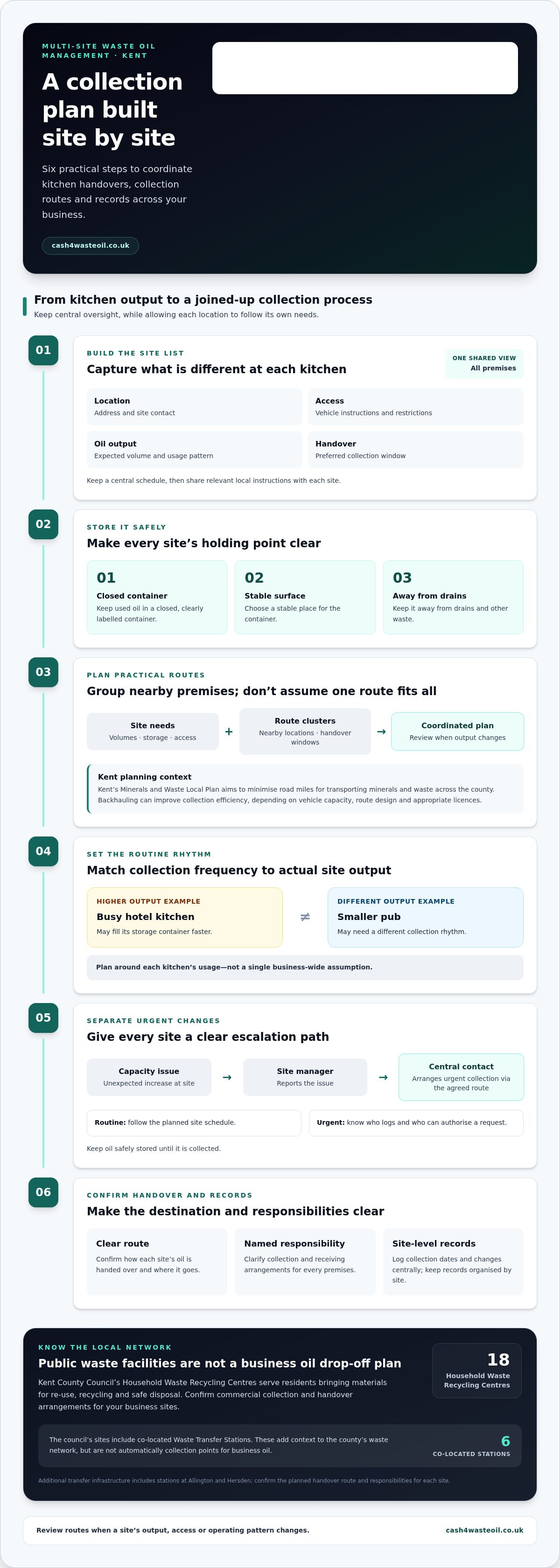
Multi-site businesses in Kent typically use commercial waste carriers that can coordinate collections across locations and provide clear records. Before collection, store used oil in a closed, clearly labelled container on a stable surface, away from drains and other waste.
Waste collection and disposal partnerships
A collection partnership should connect each kitchen’s handover to a clear destination for the oil. Ask how the route covers your separate premises, how collected oil is recorded and how the receiving arrangements support recovery. Kent has transfer infrastructure, including additional stations at Allington and Hersden, but these are not automatically collection points for business oil. Confirm the planned handover route and responsibilities for every site.
Collection logistics across multiple sites
Build one site list showing each kitchen’s location, access instructions, expected oil volumes and preferred collection window. Group nearby premises into practical routes, then review the plan when a site’s output changes. Kent’s Minerals and Waste Local Plan aims to minimise road miles for transporting minerals and waste across the county. Backhauling can improve collection efficiency, but its value depends on vehicle capacity, route design and appropriate licences.
Kent County Council operates 18 Household Waste Recycling Centres for materials delivered by residents. Businesses should distinguish those facilities from commercial collection arrangements. Six of the council’s sites have co-located Waste Transfer Stations, adding useful context to the county’s waste network without making them business oil drop-off points.
Scheduled and emergency collections
Set a regular collection rhythm around actual site output, not a single business-wide assumption. For example, a busy hotel kitchen may fill its storage container faster than a smaller pub, so record each location’s usage and adjust its schedule accordingly. Define an internal escalation step for an unexpected increase: the site manager reports the capacity issue, and the central contact arranges an urgent collection through the agreed service route.
Keep the routine and urgent processes distinct. Each site should know who logs a request, who can authorise it and where the oil remains safely stored until collection.
Reducing collection costs
Reduce avoidable trips by consolidating route planning and matching collection frequency to each kitchen’s volume. Review missed handovers, under-filled containers and access delays across the site list; these can reveal where a schedule or route needs adjusting. Backhauling may also improve efficiency and potential rebates, depending on vehicle capacity, logistics and the correct licences. Compare the full collection arrangement, not just the distance between premises.
Kent-wide service coverage
For a business with premises across Kent, coverage means more than drawing a county boundary on a map. It means planning workable routes between kitchens, assigning a clear contact for each site and keeping collection arrangements consistent. A site list can include each location, access details, oil output pattern and preferred handover window. That gives an operations manager a practical view of where coordination needs attention.
Kent’s Minerals and Waste Local Plan says transportation policy aims to minimise road miles for moving minerals and waste across the county. Businesses can apply that principle to their own collection planning. Group nearby premises into route clusters, then compare the expected journey with each site’s storage capacity and collection needs. For example, a business with kitchens in Maidstone and Canterbury can record both locations centrally and plan each handover around its actual output and access arrangements.
Separate county-wide oversight from local site instructions. A central operations contact can maintain the master schedule, while each kitchen manager reports changes such as a temporary closure, altered opening hours or restricted vehicle access. This helps prevent a site-specific change from disrupting arrangements elsewhere and gives the coordinator a clear record of which premises need revised routing.
- Record each premises’ address, site contact and vehicle access instructions.
- Group sites by practical route, rather than assuming one schedule fits every kitchen.
- Log collection dates and changes centrally, then share relevant updates with each site.
- Review route clusters when a location opens, closes or changes its operating pattern.
Coverage should also account for the difference between commercial collections and public waste infrastructure. Kent County Council’s Household Waste Recycling Centres serve residents bringing materials for re-use, recycling and safe disposal. They are not a substitute for a business collection plan. Businesses need clear handover arrangements and must ensure site staff know how stored oil is collected.
For multi-site waste oil management in Kent, use a simple coverage review: map locations, compare their operating needs, group practical routes and document exceptions. Then revisit the plan whenever a site’s access or output changes. This turns a county-wide footprint into manageable local instructions, rather than a single schedule that overlooks differences between kitchens. Businesses refining their arrangements can also review commercial collection planning as part of that process.
Waste legislation and licensing compliance
Compliance across several kitchens starts with knowing what waste is being collected and who handles it. The University of Kent states that waste oils are classed as hazardous waste and processed and recycled as fuel oils. Clear identification and controlled handovers are therefore important parts of a multi-site process. Keep the waste stream separate from general kitchen rubbish, and give each site clear instructions for storage and collection.
Licensing matters when arranging transport and recovery. The value of backhauling depends partly on whether the correct licences are in place to comply with waste legislation. For a business operating across Kent, apply one consistent approval process to every collection route. Record which carrier handles each premises, the waste stream involved and the destination arrangements. A route that includes several sites still needs suitable licensing throughout its handling chain.
Use a simple compliance review before adding a location or changing a route:
- List each site producing used cooking oil and identify the responsible site contact.
- Describe the waste stream consistently, rather than using broad labels such as “kitchen waste”.
- Confirm that collection and transport arrangements have the appropriate licences.
- Keep handover and destination details with the relevant site records.
- Review the arrangement when a carrier, route or premises changes.
Kent’s plan also draws an important distinction between waste streams. It requires management sites for green or kitchen waste exceeding 100 tonnes per week to comply with Animal By Product Regulations. That point concerns qualifying green or kitchen waste management sites. It should not be treated as a blanket rule for every used-oil collection. Classify each stream correctly before applying a requirement to a site.
For example, a hotel may produce used cooking oil alongside food scraps and green waste. Keep those streams identified separately in site procedures, and route questions about applicable rules to the person responsible for environmental compliance. This prevents a requirement attached to one waste type from being incorrectly applied to another and helps a central manager compare records across premises using consistent categories.
Keep compliance practical. Give kitchen teams a short written process covering the oil container, collection handover and person responsible for recording it. A manager overseeing several Kent sites can review the steps together, then address local differences such as delivery access or separate waste storage areas. Tie each collection record to its premises and waste description. This creates a clearer audit trail and helps identify gaps when routes or collection arrangements change.
Licensing should sit alongside, not replace, good site controls. A valid transport arrangement does not correct poor waste identification or an unclear handover. Treat each location as part of one managed system while retaining the details that show what happened at each premises.
Duty of Care records and waste reporting
For a business with several kitchens, consistent records make each oil handover easier to trace. Use one reporting process across Kent, while keeping entries identifiable by individual premises.
How do waste oil management providers compare on recycling, reporting and sustainability? Compare the clarity of their collection records, how they explain the oil’s onward handling, and whether reporting can be organised by site. Those details help you assess the service without relying on broad environmental claims.
Create a record for each collection and connect it to the site that produced the oil. Include the collection date, premises, waste description, collected quantity where recorded, and the people involved in the handover. Keep supporting documents alongside the entry. A shared system can help a central manager spot missing paperwork whilst preserving each kitchen’s own collection history.
- Use the same waste description across locations.
- Identify the premises and collection date on each entry.
- File handover documents with the corresponding record.
- Record corrections clearly instead of overwriting earlier information.
- Give each site manager a simple way to submit collection details.
The University of Kent recorded 9.21 tonnes of cooking oil waste in 2023/24. That figure illustrates why separate waste-stream data can be useful: oil records should remain distinct from broader waste totals. A business can use site-level entries to compare output, identify changes and plan collection arrangements around actual activity. For example, if one kitchen’s recorded volume rises, its manager can review recent operating changes before updating the central report.
For reporting, set a regular review point and use the same categories across every premises. Compare each site’s collection entries for gaps, unusual changes or inconsistent descriptions, then reconcile them against handover paperwork. A central spreadsheet or records system can show the combined picture, while filters or separate folders retain each location’s detail. Make sure site teams can submit information and managers can retrieve it.
Use the results to improve operations, not just file documents. Compare recorded volumes with collection frequency, then identify sites where timings or storage practices may need adjustment. Keep recycling and destination information with the relevant collection record when provided. This gives managers a clearer account of how oil is handled and supports more useful sustainability reporting across the business.
Before closing a reporting period, assign one person to check that every site has submitted its entries and supporting paperwork. Record follow-up actions against the relevant premises. A consistent process gives Kent businesses a clearer view of collection activity and helps them explain their waste management decisions using records, not assumptions.
Environmental legislation
Environmental rules shape how waste is managed across Kent, from local authority duties to wider waste policy. For businesses, the practical priority is to keep used cooking oil separate, contained and traceable, then ensure collection arrangements support responsible recovery.
Kent’s plan cites Directive 2008/98/EC as the Revised Waste Framework Directive. It provides a wider policy framework for waste management, whilst local plans and council responsibilities affect how waste services are organised. The Environmental Protection Act 1990 sets out Maidstone Borough Council’s legal obligations as a waste collection authority. The Environment Act 2021 placed additional waste separation and collection duties on Maidstone Borough Council.
The Waste and Emissions Trading Act 2023 requires councils in two-tier areas such as Kent to produce joint waste management strategies. This sits alongside the Kent Joint Municipal Waste Management Strategy, which provides direction for the Kent Resource Partnership. These provisions concern public bodies and strategic planning. A business should focus on its own waste handling, collection records and separation practices, rather than treating council duties as its operating instructions.
Water protection is especially relevant to oil storage. Kent’s plan describes groundwater as accounting for over 70% of the county’s public water supply. It defines Source Protection Zone 1 using a 50-day travel time and a minimum radius of 50 metres around the abstraction point. Zone 2 refers to a 400-day travel time from a point below the water table. These details show why preventing oil from reaching drains or bare ground matters locally.
Put practical controls in place at each kitchen:
- Keep used oil in a closed, stable container with clear identification.
- Choose a storage location away from drains and vehicle routes.
- Train staff to report leaks promptly and keep the affected area isolated.
- Record collection handovers so each site can trace its waste movement.
These steps help reduce the chance of a spill reaching a drain or groundwater. They also make environmental procedures easier to apply consistently across premises. A central manager can use one written storage process, then add site-specific instructions for drainage locations or delivery access. Review the process when a kitchen changes layout or its waste storage area moves.
Separate used oil from other kitchen waste and keep its onward handling clear in site records. To put that approach into practice, arrange used cooking oil collection for your commercial kitchen locations.
Cash 4 Waste Oil: Used Cooking Oil Collection
Cash 4 Waste Oil collects used cooking oil from commercial kitchens in Kent, including restaurants, pubs and hotels. If several premises need coordinated arrangements, its Used Cooking Oil Collection provides a practical next step after planning storage and site records. Collections include a Waste Transfer Note to support your documentation, and Cash Payments for Waste Oil are made on the spot.
The service is fully licensed and Environment Agency registered, supporting legal and environmentally responsible disposal. Keep each site’s collection details organised so your business can match handovers with its own records. This collection is for commercial kitchens handling used cooking oil.
To discuss collection for your business, visit Cash 4 Waste Oil online.
Make your next collection plan easier to manage
Use your next collection cycle to turn site procedures into a routine that teams can follow. Assign one person to coordinate changes, give each kitchen a clear handover process and review the records together. This creates a practical foundation for multi-site waste oil management in Kent, with enough flexibility to account for each location’s operating needs.
For commercial kitchens handling used cooking oil, Cash 4 Waste Oil offers Used Cooking Oil Collection, Waste Transfer Notes and Cash Payments for Waste Oil. These offerings can support a straightforward collection and record-keeping process across your sites. Set out which locations need collection and make the next step clear to the people responsible for each premises.
Contact Cash 4 Waste Oil to discuss your sites and take the next step towards a more manageable collection routine.
Frequently Asked Questions
What types of waste oil can be collected and recycled in Kent?
Commercial collections can cover used cooking oil, vegetable oil and animal fats. These are food-service waste streams, not motor oil, engine oil or industrial lubricants. For example, a restaurant can arrange collection for used fryer oil, while keeping vehicle maintenance oils separate. Cash 4 Waste Oil recycles collected oil into biodiesel. Identify the oil type accurately when arranging a collection so the site’s waste records describe the material being handed over.
How does multi-site waste oil collection and scheduling work?
Set up a central site list, then choose a collection rhythm that reflects each kitchen’s output. Cash 4 Waste Oil offers flexible weekly, fortnightly or monthly collections. For example, a hotel with a busy restaurant and a smaller pub in the same group can provide separate site details, rather than treating both kitchens as having identical needs. A central contact can coordinate arrangements, while local managers report changes to access or oil volumes.
What are typical waste oil collection and disposal prices in Kent?
Cash 4 Waste Oil’s collection service is free, and it pays cash for collected waste oil. The payment rate depends on the oil’s volume and condition, so there is no fixed per-litre figure to apply to every site. A business can gather approximate volumes and describe the oil’s condition across its kitchens when requesting a free quote. This gives the quote request practical context without assuming every premises produces the same amount.
Are there minimum volumes, collection fees or contracts for multi-site waste oil services?
Cash 4 Waste Oil has no set minimum volume, and its collection service is free. The business works with commercial kitchens of different sizes and pays cash on collection. For a group operating several premises, prepare an individual site list with each kitchen’s location and approximate oil output. This helps organise a workable collection arrangement. Keep the scope focused on commercial food-service sites producing used cooking oil, vegetable oil or animal fats.
What UK waste carrier and hazardous waste rules apply to businesses storing and disposing of waste oil?
Waste oils are classed as hazardous waste, according to the University of Kent. Businesses should keep used oil contained, separate it from general rubbish and use properly licensed collection arrangements. Cash 4 Waste Oil states that its collections are fully licensed and Environment Agency registered. For example, a kitchen should keep cooking oil apart from engine oil and other maintenance products, then record the correct waste stream at handover.
What waste transfer notes and records must Kent businesses keep for waste oil collections?
Keep the Waste Transfer Note for each collection with records identifying the premises and the waste handed over. Cash 4 Waste Oil provides a Waste Transfer Note after every collection. For a group, file each note against the site that produced the oil, rather than storing all paperwork under a general head-office record. This makes it easier to retrieve documentation for a particular kitchen and compare its collection history with internal reports.
What waste oil collection services are available across Kent towns and rural areas?
Commercial used cooking oil collection is available across Kent, including Maidstone, Canterbury, Folkestone, Medway and Tunbridge Wells. Cash 4 Waste Oil also serves London, Greater London, Surrey, Birmingham, Coventry, Leicester, Wolverhampton, Leicestershire, Derbyshire, Staffordshire, Warwickshire, Northamptonshire, Oxfordshire and Worcestershire. For a rural site, include its full location and access details in the collection arrangements. This helps distinguish the premises from nearby towns or other sites in the same business group.
How can a business set up a waste oil management contract across multiple Kent sites?
Start by contacting Cash 4 Waste Oil with your business locations and approximate monthly oil volumes. Next, arrange collections on a flexible weekly, fortnightly or monthly schedule. At collection, cash is paid and a Waste Transfer Note is issued; the collected oil is then processed into biodiesel. This four-step process gives a multi-site business a clear starting point for coordinating its collections. Keep each premises’ details ready when setting up the arrangements.